We get asked to compare materials most weeks, usually by someone who already suspects the honest answer is “it depends”, and would quite like the detail behind that answer anyway.
So here it is. Solid Surface set against quartz, granite, laminate, stainless steel and porcelain, from a fabricator who cuts all day and has no reason to pretend one material wins everything. We have included the places where we lose, because a specifier who finds those out later stops trusting the rest.
Acrylic resin with a mineral filler, made in flat sheets, then cut, routed, bonded and heat formed into shape. It is non-porous all the way through, it takes coved upstands and integrated bowls, it bends into curves, and it can be sanded back and refinished in place. Joins are inconspicuous rather than invisible, and on a well made piece you will look for them.
It contains no crystalline silica, which is becoming a specification question rather than a technical footnote. More on that below.
Quartz is harder. That is the plain truth. It resists scratching better than acrylic Solid Surface and it takes a hot pan with more tolerance, though the resin binder in quartz will still scorch, and every manufacturer still tells you to use a trivet.
Where it loses is everything after installation. Quartz joins are visible, and they stay visible. It cannot be renewed in place, so a deep scratch or a chipped edge is a replacement, not a repair. It will not thermoform, so curves are built from segments. Coved detailing and one-piece bowls are not really available to you.
Then there is silica. Engineered quartz is roughly ninety per cent crystalline silica, and cutting it produces the dust that causes silicosis. Australia banned engineered stone in 2024. In the UK there is no ban, but the HSE has prohibited dry cutting of stone worktops, is running an inspection drive, has ordered fabricators to stop work, and Unite continues to campaign for a full ban. If your client, your framework or your own health and safety policy is likely to ask what is in the material and who is cutting it, that is a live question now rather than a future one.
Choose quartz where surface hardness is the single dominant requirement and the layout is simple. Choose Solid Surface where the piece is complicated, seamless, curved, communal, or expected to be repaired rather than replaced.
Nothing looks like real stone except real stone. If the design intent is a genuine unrepeatable slab in a super prime kitchen, specify granite or marble and enjoy it.
The trade-offs are the ones stone has always had. It is porous, so it needs sealing and re-sealing. It stains. Joins are visible. Every slab differs, so a hundred identical vanities are not really on offer. It is heavy, which matters for pods, modules and upper floors. It contains silica, so the fabrication question applies here too.
Solid Surface can be made to read as marble, concrete or terrazzo, and increasingly it does it convincingly. It will not fool a stonemason at close range. It will give you the aesthetic with none of the sealing, in a form that repeats exactly and repairs in place.
Laminate is cheaper, and we would never pretend otherwise. On a tight budget, on a short lease fit-out, on something that will be replaced in five years anyway, it is a rational choice and the colour range is enormous.
It fails at the edges and the cut-outs. Water gets into the substrate around a sink and the top swells and delaminates. Damage cannot be repaired, only replaced. Joins are joins. In a washroom, a school or anywhere that gets cleaned hard, it has a short and visible life.
The comparison worth running is cost per year in place, not cost per metre. On a fifteen year building, laminate is often the more expensive option by the time you have fitted it three times.
For a commercial kitchen, stainless wins. It is heat proof, it takes steam cleaning, and the food safety regime is built around it. we would not argue against it back of house.
Front of house is different. It scratches and holds every fingerprint, it dents, it is cold to touch and cold to look at, and it is loud. Where a space needs to feel welcoming, a servery, a nurse station, a reception, a cafe counter, Solid Surface gives you the same seamless cleanable detailing with warmth, colour and a repairable finish.
Porcelain is genuinely impressive on heat, scratching and UV, and it comes in very thin sheets, which architects like.
It is also brittle. It chips at edges and around cut-outs, it needs specialist handling and specialist tooling, and fabrication options are narrower. Coving, integrated bowls and sculptural forms are difficult or impossible. Joins are visible. Repair in place is not always easy.
Specify porcelain for large flat surfaces where thinness and heat resistance are the point. Specify Solid Surface where the item has to be shaped, coved, curved, bonded seamlessly or maintained for years.
Four things, said plainly.
It is softer than quartz and porcelain, so it scratches more readily. Satin finishes and mid tones hide day to day wear far better than a gloss dark colour, and everything sands out, but it can mark.
It does not love direct heat, or though it is very heat resistant. A pan straight off the hob will leave a mark. Trivets and hot rods exist for a reason.
It costs more than laminate up front, always.
And it is not natural stone. If the design genuinely calls for a one-off slab with real geology in it, we are the wrong answer, and I will tell you that on the phone.
Ask what the surface has to survive, then work backwards.
Complicated shape, seamless runs, integrated bowls, curves, repeat units across many locations, needs to be repairable in a live building, silica is a question, then the answer is Solid Surface. Flat, simple, hardness above all, cost sensitive but not cheap, then is is quartz. Real unrepeatable material in a prime home, then natural stone is your answer. Short life, low budget, then it is laminate. Back of house food production, then stainless is the solution. Big flat thin heat exposed panels, then porcelain is the answer.
Most schemes end up using two or three of these, and that is the right outcome. The mistake is picking one material for the whole building because it was the one on the last job.
Download the comparison guide for the full side by side chart, and send us a drawing if you want a straight answer on your project.
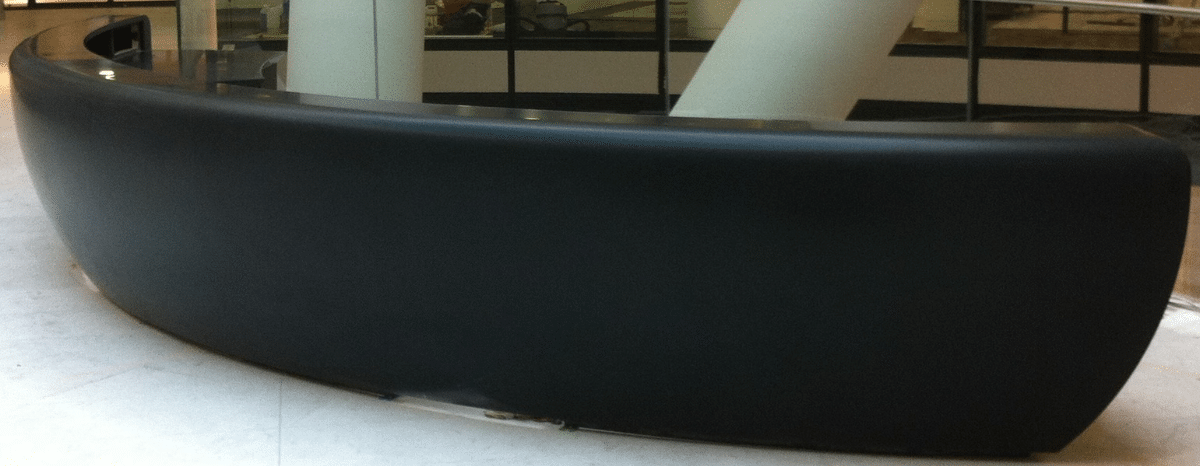
Understanding disclaimer colours in Solid Surface is important because, when it comes to Solid Surface, not every colour behaves the same way. While the full spectrum of shades allows incredible design freedom, some colours, particularly the darker, high-pigment options, require a little more care and understanding. These are often referred to as “disclaimer colours.”
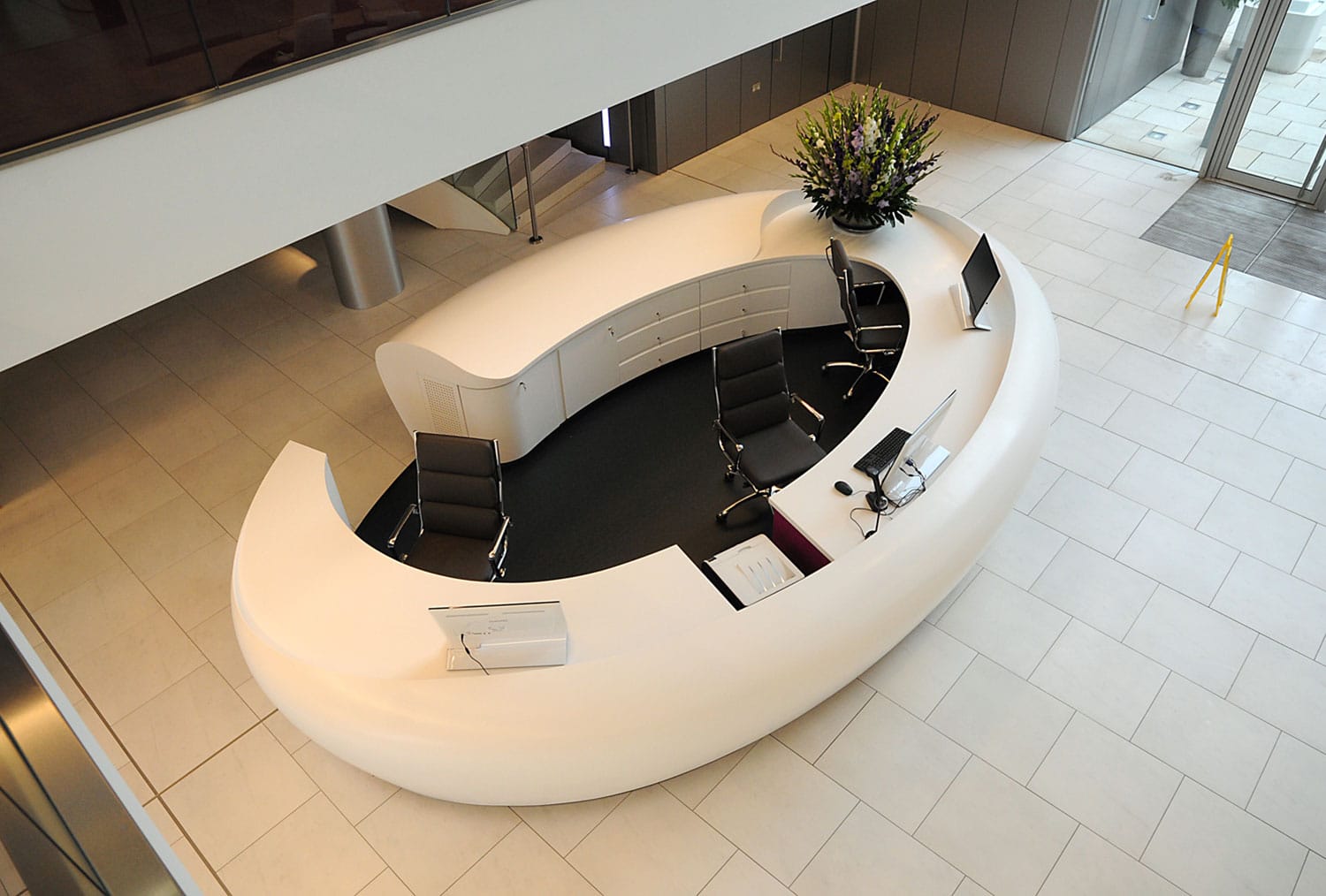
Solid Surface materials like HIMACS and Corian are revolutionising interior design with their versatility, durability, and sustainability, influencing trends in residential and commercial decor.
Need help with a project? Contact us for more details.